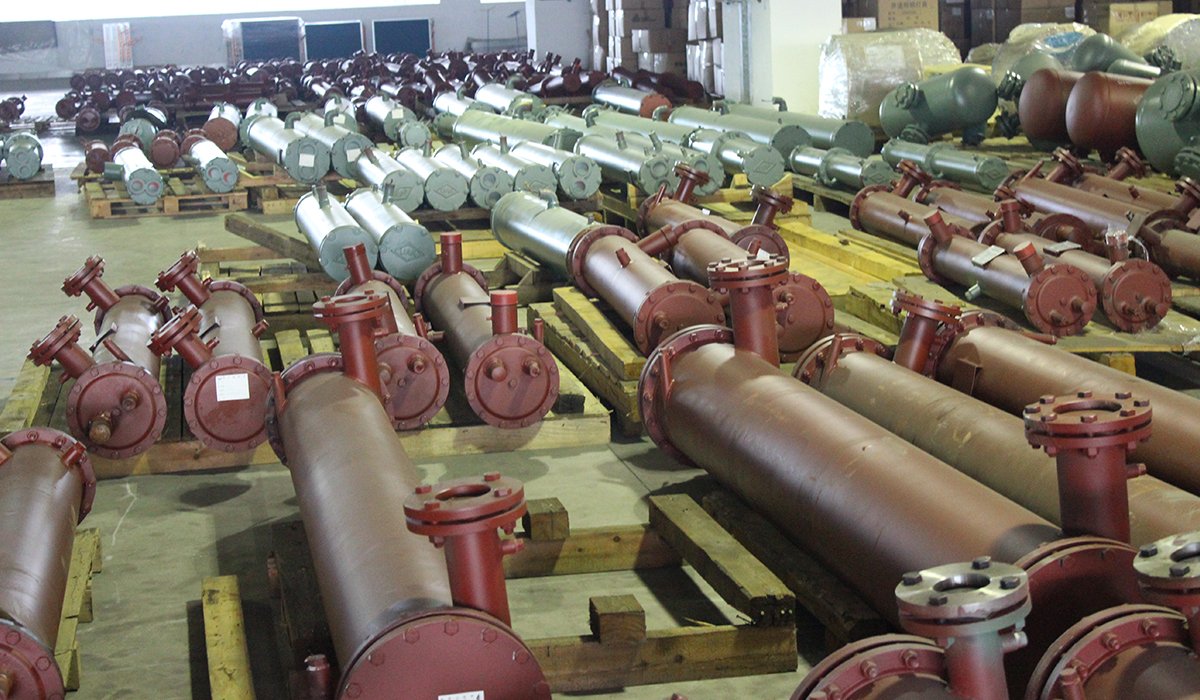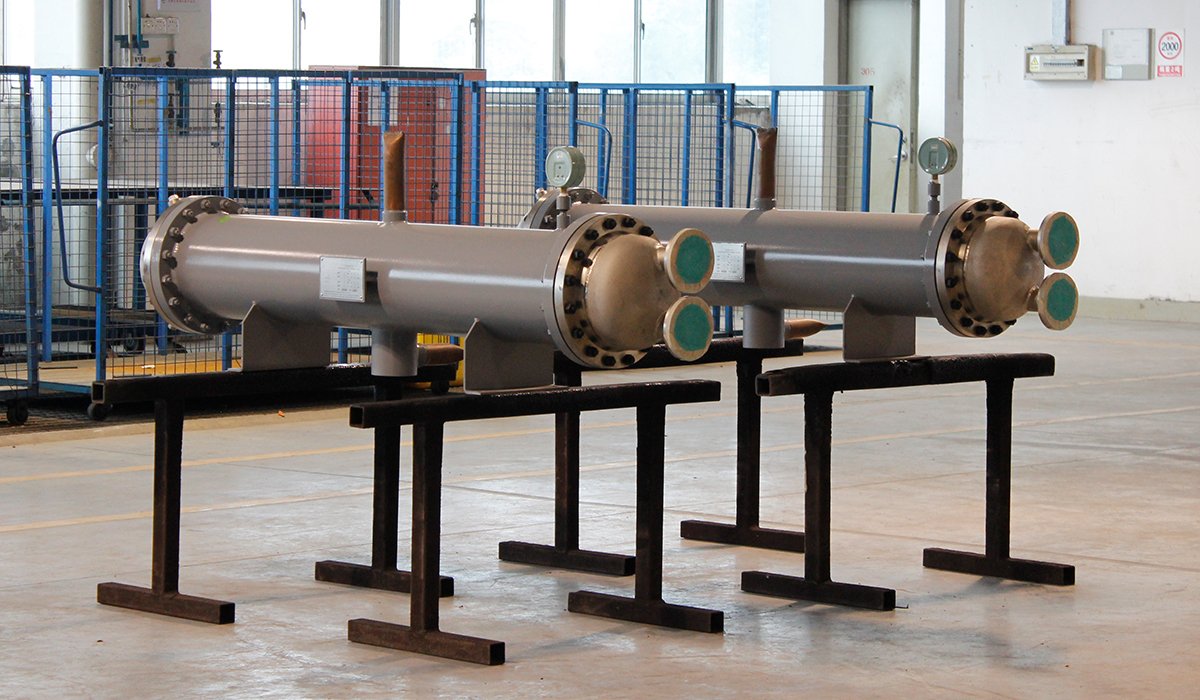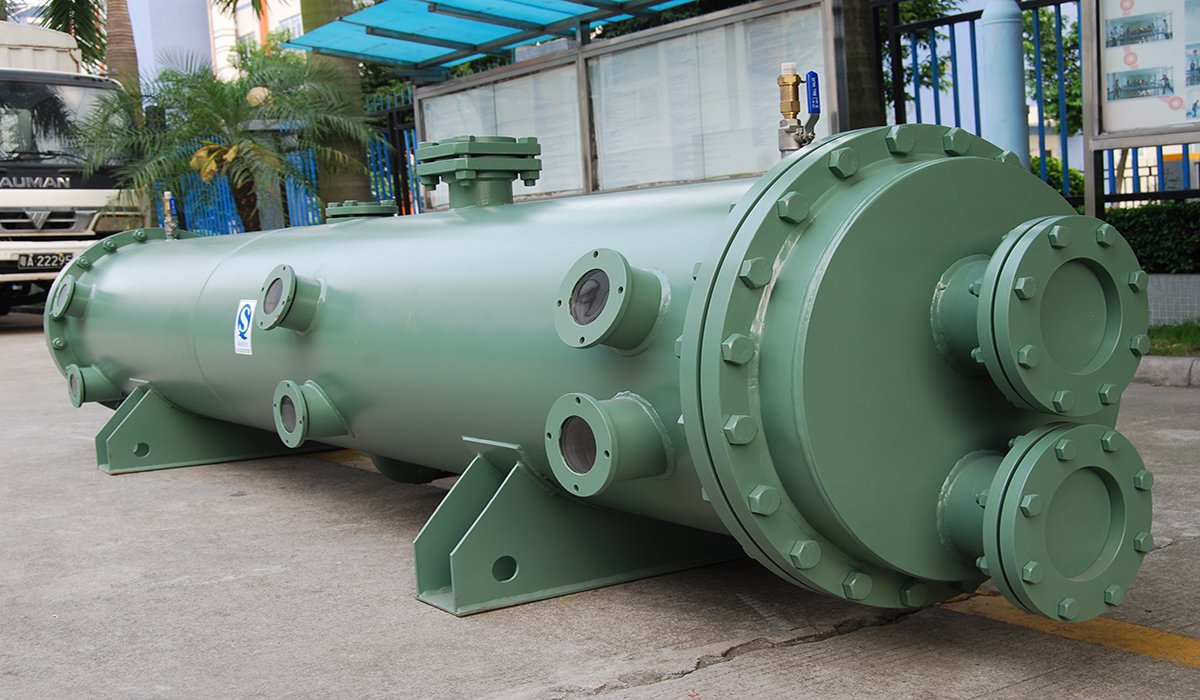
We are well aware that the type of condenser directly affects the system’s heat exchange performance, energy consumption, installation, and maintenance costs. Shell and tube condenser and air cooled condenser use water and air for heat dissipation respectively, so what are the differences between the two? How do you choose the right condenser based on your actual operating conditions? Follow us, and this article will answer all your questions.
What Are Shell and Tube Condensers and Air Cooled Condensers?
Shell and Tube Condensers
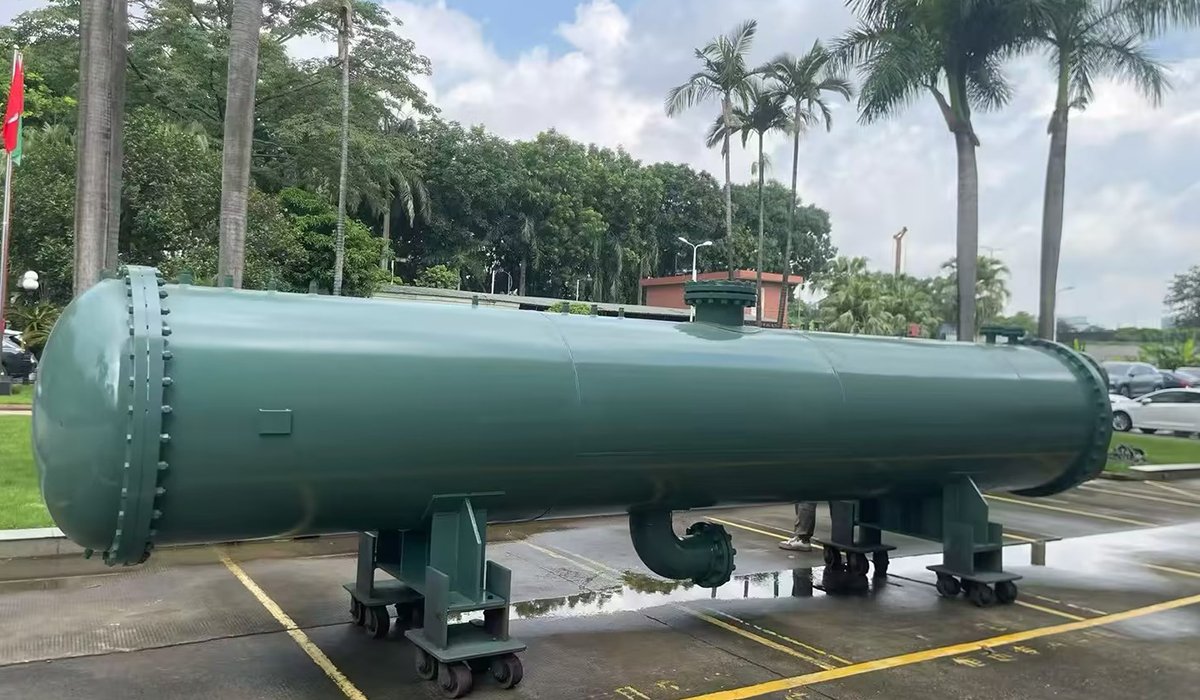
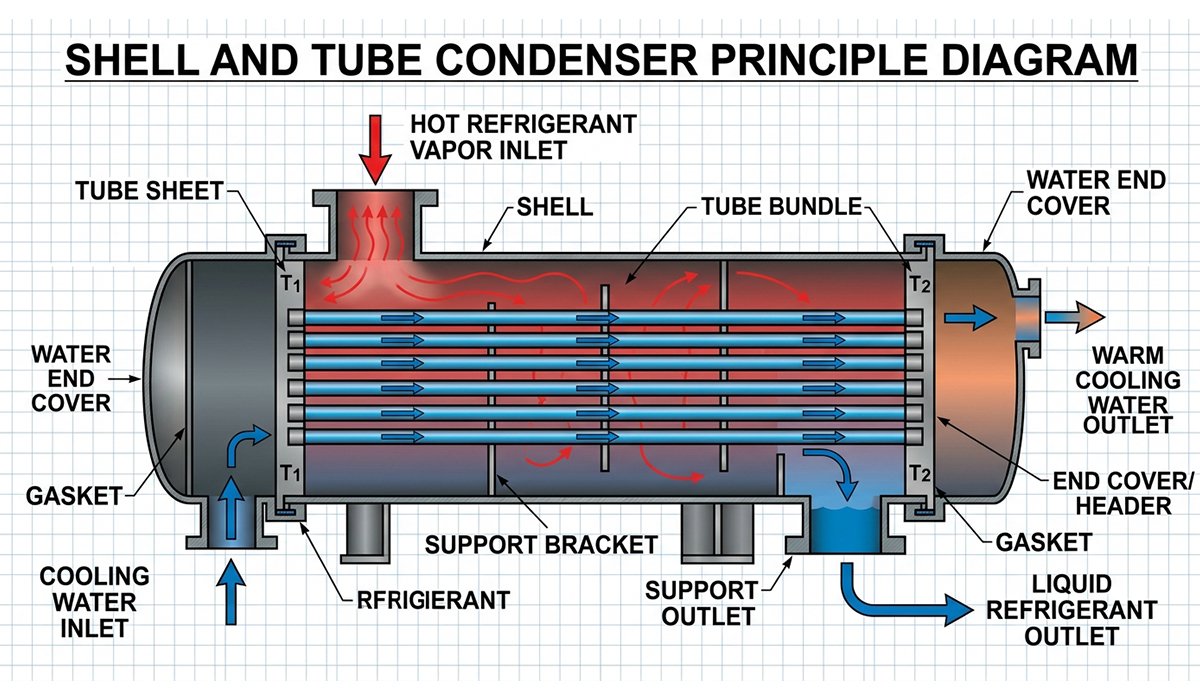
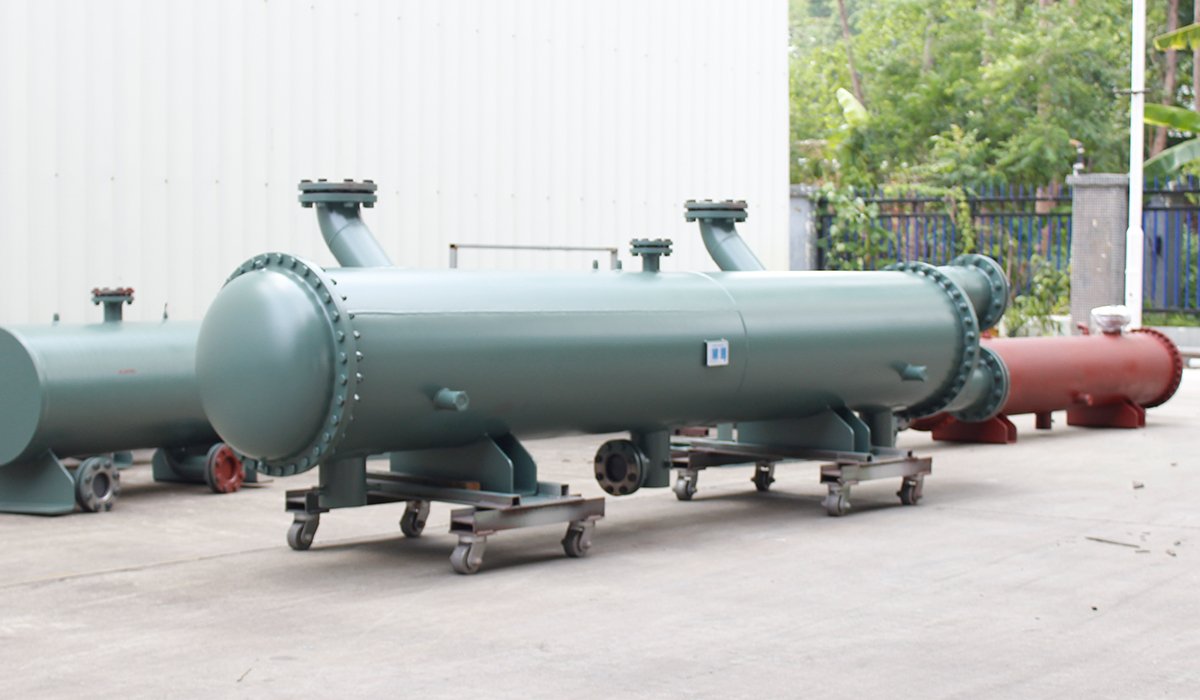
A shell and tube condenser is a type of water-cooled condenser. Shell and tube condensers can employ single-pass or multi-pass water-side flow and, depending on the design, can use structures such as fixed tube sheets or U-tubes.
Its structure typically involves cooling water flowing through a tube bundle; high-temperature, high-pressure refrigerant vapor discharged from the compressor enters the condenser. The refrigerant releases heat on the other side.
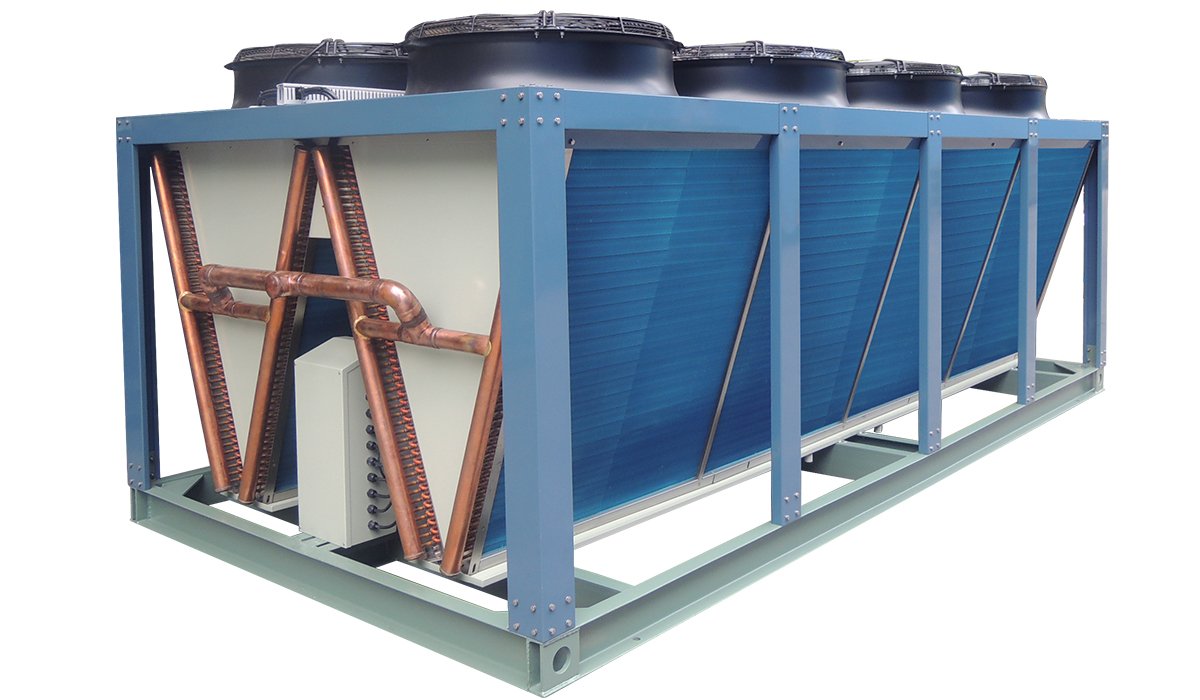
Air Cooled Condensers
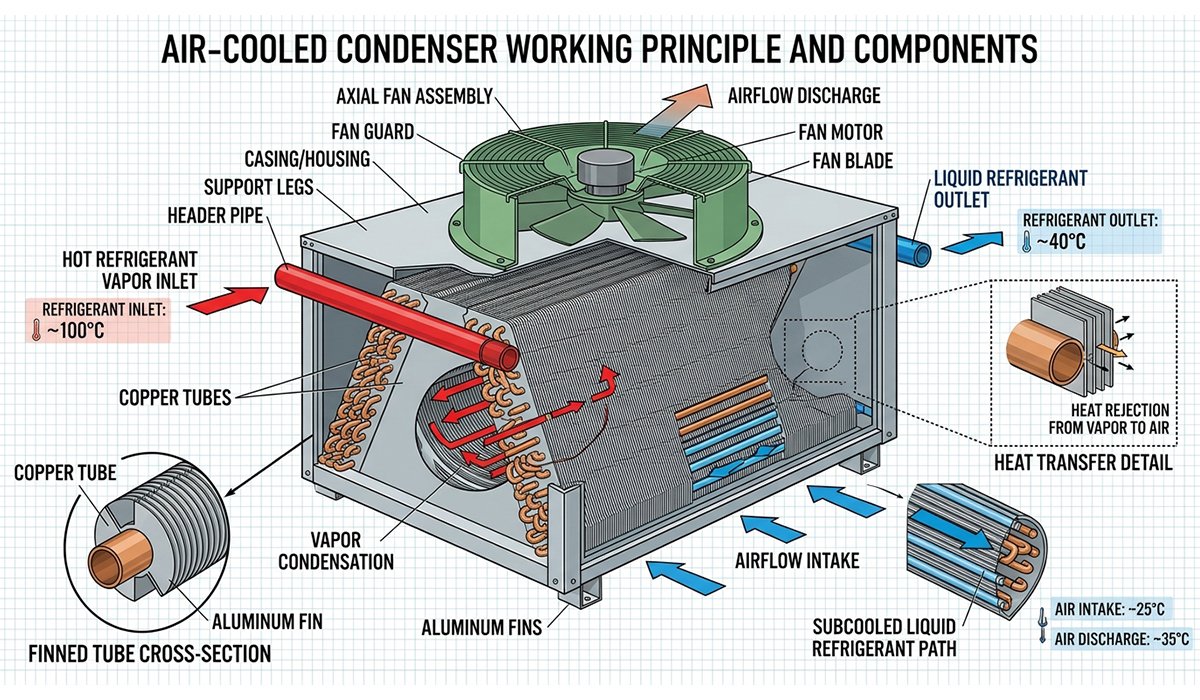
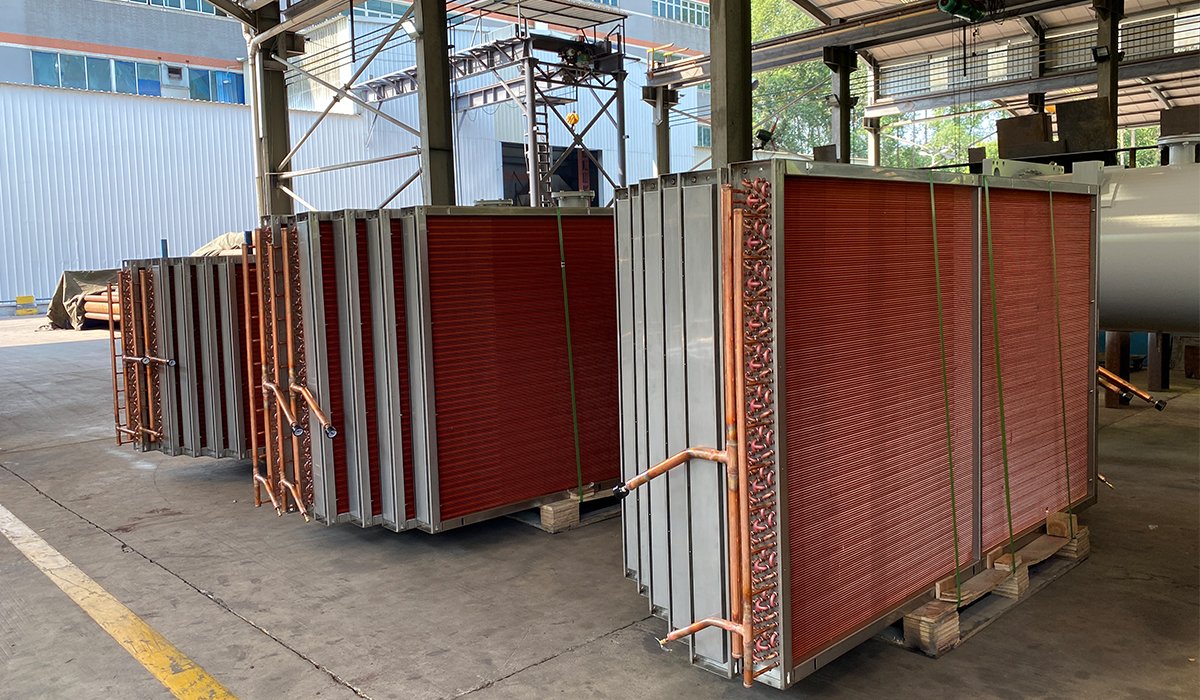
The operating principle of an air-cooled condenser is relatively simple. High-temperature, high-pressure refrigerant vapor enters the condenser coils, while ambient air flows continuously over the finned tube surfaces, driven by a fan. The refrigerant transfers heat to the air through the tube walls and fins, progressively undergoing desuperheating, condensing, and subcooling processes to ultimately transform into high-pressure liquid refrigerant.
Detailed Comparison of Shell and Tube Condenser and Air Cooled Condenser
Heat Rejection Medium
Shell and tube condensers require cooling water to flow through the heat exchange tubes to remove heat; in addition to the condenser itself, auxiliary equipment such as cooling towers and water treatment systems is typically required, necessitating a stable water source. Shell and tube condensers are less suitable for regions with scarce water resources.
Air-cooled condensers discharge heat from the refrigerant directly into the ambient air; therefore, no water is required. This feature is highly advantageous for projects located in water-scarce areas, those facing high water resource costs, or those where the construction of a cooling water system is not feasible. If your project is located in a water-scarce area, using an air-cooled condenser is the best choice.
High Heat Transfer Efficiency
Physically, the thermal conductivity and convective heat transfer capability of water are typically far higher than those of air. Therefore, under identical heat transfer conditions, a higher heat transfer coefficient can be achieved on the water side. If water resources in your project’s location are not particularly scarce, we highly recommend using a shell and tube condenser. This can significantly improve heat transfer efficiency.
Water Treatment
The use of water in shell and tube condensers can lead to issues such as scaling, corrosion, clogging, and biological fouling. Therefore, water quality control is necessary; otherwise, the heat exchange performance of the newspaper will decrease, increasing subsequent maintenance costs. Air-cooled condensers do not require water, so this issue does not need to be considered.
Ambient Temperature Impact
Shell and tube condensers do not directly utilize ambient air as the ultimate heat sink. Consequently, the ambient temperature has a minimal impact on shell and tube heat exchangers. If the ambient temperature at your project site fluctuates significantly, a shell and tube condenser is a more suitable choice.
This is one of the most significant technical limitations of air cooled condenser.The condensing temperature of an air-cooled condenser is directly related to the ambient dry-bulb temperature; consequently, performance is significantly affected under high ambient temperature conditions. If the ambient temperature rises from 25°C to 40°C, the heat transfer driving force of the air-cooled condenser will change significantly.
If your project is located in an area with large ambient temperature fluctuations, it is recommended that you exercise caution when selecting an air-cooled condenser.
Footprint
The shell and tube condenser unit is typically quite compact. Due to water’s superior heat transfer capability, shell-and-tube condensers typically do not require the large fin surface areas and high airflow rates needed by air-cooled condensers for the same heat load. However, a complete water-cooling system also requires components such as cooling towers and water treatment equipment, which also take up space.
Air-cooled condensers use air to dissipate heat. Due to the relatively low heat transfer capacity of air, as the heat load on the condenser increases, larger fans and more fins are required. Air-cooled condensers also require sufficient surrounding space to ensure air circulation. The equipment dimensions also typically increase significantly.
Noise
The shell and tube condenser itself is typically not a primary source of noise; however, attention must be paid to the noise and vibration generated by the compressor, cooling water pumps, cooling tower, and the flow of refrigerant and water.
Air-cooled condensers typically tend to generate noticeable operating noise because they require fans. Fans are a source of additional energy consumption and also generate noise. Therefore, for hotels, residences, hospitals, and noise-sensitive facilities, acoustic design requires special consideration. Otherwise, the noise could affect the local population and potentially lead to unnecessary trouble.
Installation
The shell and tube condenser requires cooling water; therefore, cooling towers and water treatment systems are also necessary. There are many pipes involved in the installation process. Relatively speaking, the installation is relatively complex. For some more complicated setups, local engineers may be needed to assist with the installation.
Since air-cooled condensers do not require a cooling water system, the configuration of the entire system is simpler. It mainly consists of the condenser coil and the fan. Fewer tubes and simple installation make initial construction more convenient. If you are dealing with small-scale projects, distributed equipment, or projects requiring rapid installation, an air-cooled solution is usually more convenient.
Maintenance
Using water in a shell and tube condenser carries the risk of scaling. Tube fouling is a very direct consequence of improper water treatment. If scale gradually forms inside the water tube, the thermal resistance of the tube wall increases, and heat transfer efficiency decreases.
Therefore, you need to regularly perform tube cleaning, descaling, water quality monitoring, and corrosion inspections to ensure the shell and tube condenser operates properly.
Since no cooling water flows through the heat exchange tubes of an air-cooled condenser, issues such as scale, deposits, and corrosion on the water side—which would otherwise impair heat transfer performance—do not occur. Therefore, you do not need to perform water treatment, descaling, pipe cleaning, etc.
However, this does not mean that air-cooled condensers require no maintenance; the coils must be regularly cleaned to remove dust and debris. It is also essential to inspect the fans, motors, and fins.
| Factor | Shell and Tube Condenser | Air Cooled Condenser |
| Heat rejection medium | Water | Air |
| Heat transfer efficiency | High | Moderate |
| Water consumption | Required | None |
| Initial cost | Higher system cost | Generally lower |
| Operating cost | Depends on water system | Fan power required |
| Maintenance | Tube cleaning required | Coil/fan cleaning |
| Footprint | Compact | Larger |
| Ambient temperature impact | Lower | Higher |
| Water quality | Important | Not applicable |
| Installation | Requires water system | Simpler |
| High-capacity systems | Excellent | Possible but larger |
| Industrial applications | Very suitable | Suitable depending on conditions |
| Noise | Generally lower | Fan noise |
| Outdoor installation | Possible | Common |
| condensing temperature | compressor power | system efficiency |
| Pressure drop | Depends on tube-side design | Depends on coil and airflow design |
| Cooling capacity | Well suited for medium/large systems | Suitable for small/medium systems |
| Cooling tower | Usually required in water-cooled systems | Not required |
Shell and Tube Condenser vs Air Cooled Condenser: Which One Should You Choose?
Choose a Shell and Tube Condenser If:
- Large Cooling Capacity
- High Ambient Temperature
- Reliable Cooling Water is Available
- Water Quality Can Be Controlled
- Space is Limited
- Stable Long-term Operation is Important
- Heat Recovery is Required
The characteristics of shell and tube condensers make them a suitable choice for large-scale or continuously operating refrigeration systems, applications requiring stable condensing conditions under high ambient temperatures, or situations with specific space constraints. Another eco-friendly feature is that a shell and tube condenser is the ideal choice when you need to utilize recovered condensation heat for applications such as hot water supply or process heating.
Of course, opting for a shell and tube condenser requires ensuring a stable supply of cooling water, as well as proper water treatment and maintenance capabilities. Without these conditions, the condenser you purchase may become unusable or suffer from poor heat transfer efficiency.
Choose an Air Cooled Condenser If:
- Cooling water is unavailable or limited.
- A simple system is preferred.
- Easy installation is important.
- Low maintenance is preferred.
- Small or medium-capacity systems
- Outdoor installation is available.
- The water quality is poor.
Unlike shell and tube condensers, air-cooled condensers rely on sufficient outdoor airflow. When limited water resources and simple system operation are the primary considerations—and provided the unit can be installed outdoors with adequate airflow—an air-cooled condenser should be selected.
Using an air-cooled condenser eliminates the need for cooling towers, water pumps, and water treatment systems, thereby reducing installation complexity and future maintenance issues. Since no water system is used, you can also avoid issues such as structural problems or corrosion caused by water quality that would otherwise affect heat transfer efficiency.
Shell and Tube Condenser vs Air Cooled Condenser for Different Applications
Shell and Tube Condenser
Typically, users with specific requirements for cooling capacity, long-term operation, and system stability tend to choose shell and tube condensers. If you operate in any of the following industries and have abundant water resources, the shell and tube condenser is a preferred choice. Shell-and-tube condensers are widely used in:
- Industrial Chillers
- Process Cooling
- Data Centers
- Chemical Industry
- Pharmaceutical Industry
- Food and Beverage Processing
- Large-scale Commercial HVAC Systems
Air Cooled Condenser
If an air-cooled condenser needs to dissipate a large amount of heat, then it requires a larger airflow, a larger fin area, and a larger fan; therefore, it will require more space. If you require a simple installation system and do not need to use water resources, an air-cooled condenser is more advantageous. Therefore, air-cooled condensers are generally more suitable for:
- Small and Medium-sized Commercial HVAC Systems
- Integrated Chiller Units
- Commercial Buildings
- Cold Storage Facilities
| Application | Typically Preferred |
| Industrial chiller | Shell & Tube |
| Process cooling | Shell & Tube |
| Large Commercial HVAC | Shell & Tube |
| Central Chilled Water Systems | Shell & Tube |
| Data Centers | Shell & Tube / Air Cooled |
| Chemical Industry | Shell & Tube |
| Pharmaceutical Industry | Shell & Tube |
| Food & Beverage Processing | Shell & Tube |
| Small Commercial HVAC | Air Cooled |
| Packaged Chillers | Air Cooled |
| Office Buildings | Air Cooled |
Can a Shell and Tube Condenser Replace an Air Cooled Condenser?
Yes, but there are prerequisites. The choice of condenser depends on the availability of a cooling water system, as well as the system’s heat exchange requirements and installation conditions.
Shell and tube condensers require a cooling water circulation loop; consequently, they typically necessitate the inclusion of a cooling tower, water pumps, piping, and a water treatment system. If your project has a reliable cooling water supply and can accommodate a more complex water system, a shell-and-tube configuration can serve as an alternative to an air-cooled solution.
However, if your project lacks cooling water or the installation site is remote—or if you prefer a simple system that is easy to install—an air-cooled condenser is usually more suitable.
It is important to remember that the two are not arbitrarily interchangeable; we must re-evaluate the selection and design based on the entire refrigeration system to identify the product solution best suited to your project.
How to Select the Right Condenser?
Selecting a suitable condenser requires considering the following factors:
- Required Cooling Capacity
- Refrigerant
- Ambient Temperature
- Cooling Water Available
- Water Temperature
- Water Quality
- Operation be Continuous or Intermittent
- Noise Requirements
- Installation Space
- Cooling Tower
- Design Pressure
Whether using a shell and tube condenser or an air-cooled condenser, cooling capacity is a crucial factor. Only the right cooling capacity can ensure maximum efficiency for your project. Different operating modes affect design conditions, equipment reliability, and long-term service life requirements. This affects the calculation of the heat transfer temperature difference and the required heat transfer area for the condenser. You need to provide accurate inlet and outlet water temperatures to obtain a suitable condenser design. This determines the design requirements for the shell, tube, tubesheet, and other pressure-boundary components; it is a crucial factor. Providing an incorrect design pressure could lead to the risk of condenser leakage or damage, resulting in financial losses or downtime. If your country has requirements regarding eco-friendly refrigerants, you can choose options such as R1234ze, R454c, or R454a. If you are looking for cost-effective refrigerants, you can choose R32, R454b, R513a, or R290.
FAQs
Can Air Cooled Replace Shell & Tube?
It is possible, but the design must be tailored to the project’s specific refrigeration system as a whole. In certain special cases, substitution is not feasible; otherwise, it could introduce cost or schedule risks to your project.
Which condenser has lower operating costs?
Generally speaking, large-scale projects requiring continuous operation are usually better suited to water-cooled condensers, whereas for small-scale projects or in water-scarce regions, air-cooled condensers may offer lower overall operating costs.
Which condenser requires more maintenance?
shell and tube condenser:The cooling water side is susceptible to scaling, corrosion, deposits, and microbial contamination; therefore, water quality management is required, and heat exchanger tubes must be cleaned periodically based on actual conditions. Shell and tube condensers require significant maintenance on the water side.
It is necessary to regularly clean dust and debris from the coils and inspect the fan, motor, and fins. Overall system maintenance is relatively simple.
Which condenser is better for high ambient temperatures?
Generally speaking, shell-and-tube condensers are better suited for large-scale refrigeration systems operating in high ambient temperatures, provided there is a reliable cooling water system.
Which condenser is better for industrial chillers?
For large-scale industrial chillers, a shell-and-tube condenser is typically the more common choice.
Customized Shell and Tube Condenser Solutions
UAR has over 30 years of experience in manufacturing shell-and-tube condensers. Our condensers meet international standards, and we can provide certifications such as ASME, PED, and CE.
At UAR, we apply rigorous standards to tailor the ideal condenser solution to the specific requirements of your project, addressing every detail. Drawing on over 30 years of experience in customizing shell-and-tube condensers, we prioritize long-term value, delivering equipment that is both stable and durable. Contact us today.